|
Shoreline Instruments Pickups/Preamps Amplifiers Accessories Specials Shipping Guitarists
|
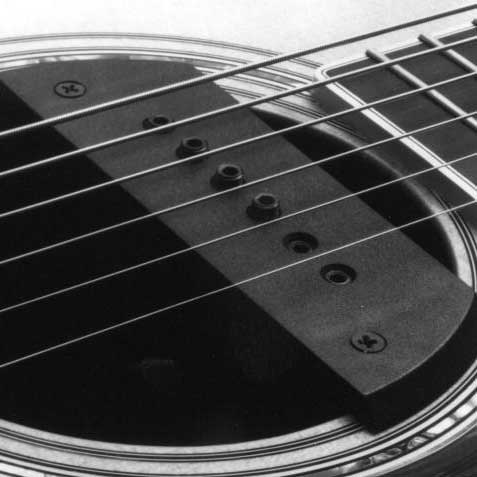
About two-thirds of our email correspondence with customers is dedicated to answering this very question, so I suppose this would make it the MFAQ*. It should be said at the outset that pretty much any pickup solution is a compromise. The best way to amplify your acoustic guitar's sound is with one or two high-quality microphones placed in front of your soundhole. But in the real world, such a setup is pretty much impossible. There's a host of reasons almost all pro guitarists use pickups, including feedback resistance and mobility, not to mention the convenience of plugging in and playing or the advantage of onboard tone and volume controls. The challenge, then, is to find a pickup that is convenient to use while sounding as close as possible to those microphones. It's often true, though, that what you gain in convenience, you lose in tone--many pickups that resist feedback and are really easy to install can make your acoustic guitar sound like an electric guitar when plugged in. For many players, this trade-off is acceptable. Many players, however, prefer a more natural-sounding pickup, even with the higher risk of feedback. One popular type of natural-sounding pickup is the soundboard pickup (or soundboard transducer). I normally recommend these because of their remarkably natural tone, ease of installation, and minimal modification to your guitar. Whether you're performing in small venues or recording in a home studio, it's very likely that some variety of soundboard transducer will cover most of your bases. But no pickup is perfect, and even the best soundboard pickups may produce feedback at high stage volumes. Although I only take a Renaissance guitar onstage these days, I have used soundboard pickups in my other guitars, and despite often playing in full band situations, I never, ever fed back. But feedback is still a distinct possibility if the room's ambient acoustic just doesn't play nice, so standalone soundboard pickups should always be approached with caution. So, with all this in mind, several questions are worth answering before choosing a pickup: • Will you be playing in a loud band setting? If you're going to be playing in a loud band, it's worth remembering that the natural acoustic tone of your guitar is not necessarily the best tone to have, since it will get lost in the mix, and people will only hear your pick moving across your strings and not much else. For both feedback resistance and tone that cuts through, your best bet in these situations is probably a soundhole or undersaddle pickup. While it won't be the most natural tone (although some models get very close), the ability to cut past the drums and bass without feeding back makes the compromise more than worth it. Undersaddle pickups have the advantage of being invisible to your audience, while soundhole pickups have the advantage of minimizing the necessary surgery on your guitar. Soundhole pickups also tend to cut through the mix better than any other kind of pickup. And while most soundhole pickups use magnetic coils just like the pickups in a Strat, the models we carry do a remarkable job of reproducing the character of your guitar, all while helping you to cut through the mix. If you're playing solo, or in a small acoustic combo, or in a setting where you're not in cramped quarters with your rhythm section, your best bet for natural tone will almost certainly be some sort of soundboard pickup. If you don't mind a little tweaking onstage to get your sound right, then it might be worth investing in a dual source pickup. These normally combine an undersaddle + mic or a soundboard pickup + mic. The mixture of strings, wood, and air that dual-source setups can produce does sound quite good. They do take some blending and extra EQ, often in between songs onstage, but the resulting tone can be worth the extra effort. All of these pickup systems--soundboard, undersaddle, soundhole, dual source--can be installed with controls and extra electronics right on the side of your guitar. Since this usually means cutting at least one extra hole in your guitar, you need to decide whether the added convenience is worth the surgery on your instrument. Most customers decide against onboard controls for just this reason. However, many factory guitars come with side-mounted electronics already in place, and in these cases, it's worth considering dual-source upgrades from Baggs and Fishman, many of which are designed to fit in the holes created by standard onboard Fishman gear. Here's a table with listings for all these pickup types, as well as examples from the stuff that we carry. If you're still stumped after reading through this, please don't hesitate to contact us and we'll help you find the right pickup.
|